
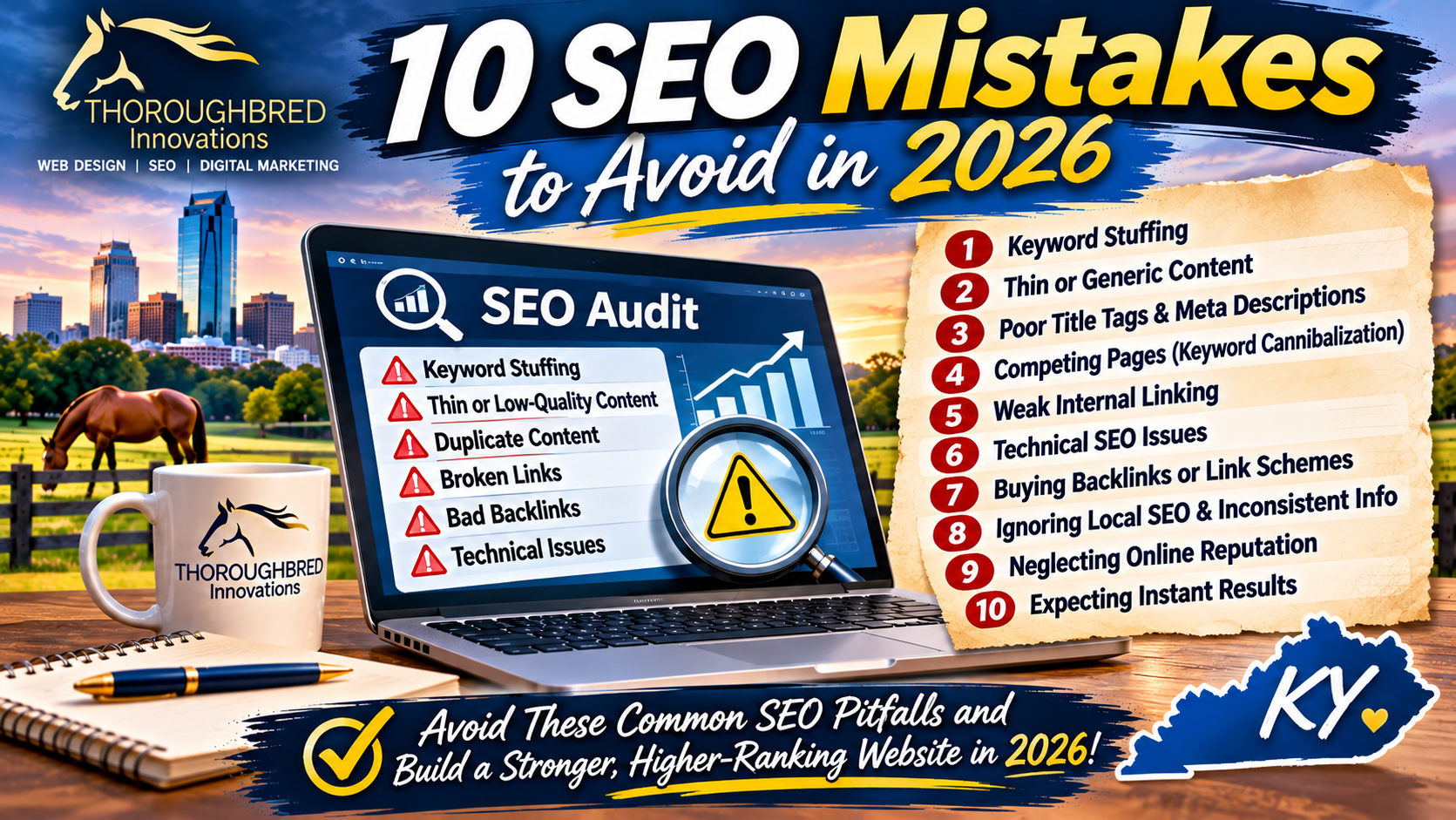
Search engine optimization has changed considerably over the years, but one thing remains true: bad SEO practices can prevent even a well-designed website from reaching its full potential.
In 2026, businesses have access to more SEO tools, artificial intelligence, automated content generators, and digital marketing resources than ever before. Yet many websites continue making the same fundamental mistakes.
Some businesses focus too heavily on keywords. Others purchase questionable backlinks, publish low-quality content, or neglect the technical details that help search engines understand their websites.
The frustrating part? Many of these mistakes are completely avoidable.
At Thoroughbred Innovations, we’ve seen how important it is for small businesses to understand what works in SEO—and what doesn’t.
Whether you’re managing your own website or working with a digital marketing company, knowing the most common SEO mistakes to avoid can help you make better decisions about your online presence.
Rather than covering everything involved in building an SEO strategy, we’re focusing specifically on ten mistakes that businesses should stop making.
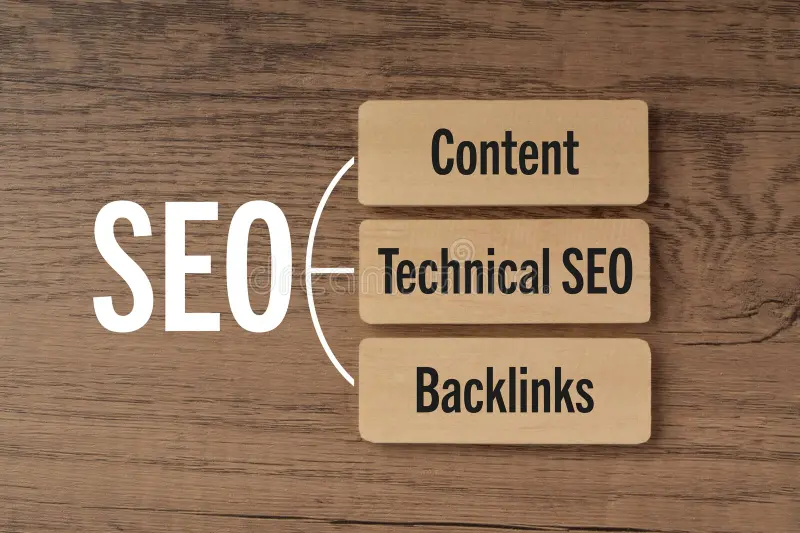
Some involve on-page SEO, which concerns the content and elements of your website. Others involve off-page SEO, which includes backlinks, online reputation, and signals from outside your website.
Let’s examine ten common SEO mistakes that can undermine your search visibility in 2026.
1. Keyword Stuffing: Repeating the Same Phrase Everywhere
Type: On-Page SEO Mistake
There was a time when some website owners believed repeating a keyword as frequently as possible would help them rank higher in Google.
Unfortunately, that outdated mindset still exists.
Keyword stuffing occurs when a website unnaturally repeats keywords in an attempt to manipulate search rankings.
Imagine a Lexington roofing company’s homepage containing this paragraph:
“We provide roofing Lexington KY services. If you need roofing Lexington KY, our roofing Lexington KY company offers the best roofing Lexington KY solutions for roofing Lexington KY customers.”
Not exactly enjoyable reading, is it?
The paragraph sounds robotic, provides almost no useful information, and makes the business appear unprofessional.
Keyword stuffing can occur in website copy, headings, title tags, image alt text, and even internal links.
Google specifically identifies keyword stuffing as a spam practice in its Search spam policies.
The mistake: Prioritizing keyword repetition over natural, helpful writing.
What to do instead: Use your primary keyword where it makes sense, particularly in the page title, main heading, and relevant content. Incorporate related terminology naturally and focus on answering the questions your customers actually have.
For example, a roofing company could discuss roof inspections, storm damage, residential repairs, commercial roofing systems, and the Kentucky communities it serves.
That provides substantially more value than repeating the same phrase twenty times.
Remember: You’re writing for people first, not trying to impress Google with how many times you can repeat a keyword.
2. Publishing Thin, Generic, or Mass-Produced AI Content
Type: On-Page SEO Mistake
Artificial intelligence has made creating website content faster and easier.
Unfortunately, it has also made publishing enormous quantities of generic articles easier.
Some businesses generate dozens of blog posts, make almost no edits, and publish them simply to target additional keywords.
The result is often content that repeats common information without providing original insight, practical guidance, or meaningful value.
For example, imagine an HVAC company publishing fifteen articles about air conditioning maintenance.
Every article contains essentially the same advice, just with different titles and slightly rearranged sentences.
Visitors may quickly realize that none of the articles provides anything particularly useful.
Google’s guidance on helpful, reliable, people-first content encourages website owners to provide original information, meaningful explanations, and content that satisfies readers’ needs.
Using AI to assist with content creation isn’t automatically a violation of Google’s policies. The concern arises when content is produced at scale primarily to manipulate rankings rather than help users.
The mistake: Publishing content for the sake of publishing, without considering whether it adds value.
What to do instead: Prioritize quality over quantity.
Include real business expertise, accurate service information, practical examples, original photographs when relevant, and answers to specific customer questions.
A plumbing company could explain common problems it encounters in Kentucky homes. A restaurant could discuss its actual menu, preparation methods, or catering options.
Those details make content more useful and distinctive.
Ten genuinely helpful articles can serve your customers better than fifty nearly identical posts.
3. Ignoring Title Tags, Meta Descriptions, and Heading Structure
Type: On-Page SEO Mistake
Some businesses spend hours writing website content but overlook the elements that help organize and describe it.
One common example is using vague page titles such as “Home,” “Services,” or “Welcome to Our Website.”
These titles don’t clearly explain what the page offers.
Other businesses make the opposite mistake by stuffing several keyword variations into a single title.

Consider the following examples:
Poor title: Roofing Lexington KY | Roofers Lexington | Best Roofing Kentucky | Roofing Company
Better title: Residential Roof Repair in Lexington KY | Company Name
The second title is more specific, readable, and relevant to the page’s purpose.
Google’s title link documentation recommends descriptive, concise titles and warns against keyword stuffing and repetitive titles.
Meta descriptions also deserve attention.
Although meta descriptions aren’t a direct Google ranking factor, Google may use them when generating search snippets. A clear description can help customers understand what they’ll find after clicking.
Heading structure matters, too.
A page should have a clear main heading, with relevant subheadings organizing its content logically.
The mistake: Leaving important page elements generic, duplicated, misleading, or overloaded with keywords.
What to do instead: Give important pages descriptive, distinct titles and organize their content with meaningful headings.
Write meta descriptions that accurately summarize the page and encourage relevant visitors to learn more.
Don’t worry about forcing every possible keyword into every element.
Clarity is more valuable than repetition.
4. Creating Multiple Pages That Compete for the Same Keyword
Type: On-Page SEO Mistake
Publishing more pages doesn’t automatically create more opportunities to rank.
Sometimes, businesses unintentionally create several pages targeting essentially the same search intent.
This is commonly called keyword cannibalization.
Imagine a Lexington web design company publishing separate articles titled:
Website Design Lexington KY
Lexington KY Website Design
Website Designers in Lexington Kentucky
Professional Website Design Lexington
If all four pages provide nearly identical information and target the same audience, they may compete for similar searches rather than serving distinct purposes.
Google can still rank multiple pages from the same website, and overlapping keywords aren’t automatically harmful.
The problem arises when pages duplicate one another without offering meaningful differences.
This can confuse visitors, dilute internal linking efforts, and make it harder to determine which page should serve as the primary resource.
The mistake: Creating a new page for every slight keyword variation, regardless of whether the search intent is different.
What to do instead: Group closely related keywords by intent.
Create one strong page for a primary topic and develop supporting articles that address genuinely different questions.
For example, a main web design service page could be supported by separate articles about website accessibility, mobile optimization, conversion-focused design, and website maintenance.
Each page would serve a distinct purpose while supporting the broader topic.
Before publishing another article, ask yourself:
Does this page offer something meaningfully different from what we’ve already published?
If the answer is no, improving an existing page may be the best decision.
5. Neglecting Internal Links and Leaving Important Pages Isolated
Type: On-Page SEO Mistake
Internal links connect pages within your own website.
They’re important because they help visitors discover related information and allow search engines to understand relationships between pages.
Yet internal linking is frequently overlooked.
Imagine a small business has an excellent article about the benefits of professional website design.
The article attracts visitors, but it doesn’t link to the company’s actual web design services.

Interested readers may finish the article without knowing where to go next.
Another common problem is creating orphan pages—pages that have no internal links pointing to them.
These pages may be difficult for visitors and search engines to discover through normal website navigation.
Google’s link best practices recommend descriptive anchor text and internal links that help users and search engines understand related content.
The mistake: Publishing pages without connecting them to other relevant information on your website.
What to do instead: Link naturally between related articles, services, and resources.
For example, an article about common SEO problems could link to Thoroughbred Innovations’ SEO services in Lexington.
An article about outdated websites could link to its web design services for small businesses.
The goal isn’t to insert as many links as possible.
It’s to help readers discover the next useful page.
6. Ignoring Technical SEO Problems That Prevent Google From Accessing Your Website
Type: Technical and On-Page SEO Mistake
You can have excellent content, carefully researched keywords, and a beautiful website, but none of that matters much if search engines cannot properly access your important pages.
Technical SEO problems are particularly frustrating because they aren’t always visible to ordinary website visitors.
For example, a website owner might accidentally apply a noindex directive to an important service page.
That directive tells search engines not to include the page in their indexes.
Other problems include broken redirects, incorrect canonical tags, inaccessible navigation, and internal links pointing to deleted pages.
Imagine a Kentucky landscaping company redesigning its website.
During development, the new website is configured to discourage search engine indexing. Unfortunately, that setting remains active after launch.
The company publishes its new website and waits for rankings to improve, unaware that important pages are being excluded from Google.
The mistake: Assuming that because a website looks and functions correctly to visitors, its technical SEO must also be correct.
What to do instead: Regularly monitor important pages using Google Search Console.
Check indexing status, review crawl errors, investigate unexpected traffic changes, and verify that redirects work properly.
Google’s Search Essentials explains the technical requirements and best practices that help websites become eligible for Google Search.
Technical SEO doesn’t need to be mysterious, but overlooking it can undermine everything else you’re doing.
7. Buying Backlinks or Participating in Link Schemes
Type: Off-Page SEO Mistake
Backlinks are links from other websites pointing to yours.
Relevant, legitimate backlinks can help search engines discover your content and understand its reputation.
However, not all backlinks are equally valuable.
Some businesses become so focused on acquiring links that they begin purchasing backlinks from questionable websites or participating in artificial link exchanges.
For example, a Kentucky restaurant might pay a company promising 5,000 backlinks for $99.
Those links could come from unrelated websites, automated directories, or networks created primarily to manipulate search rankings.
The number sounds impressive, but the quality and legitimacy of those links are questionable.
Google’s spam policies identify manipulative link-building practices, including buying or selling links for ranking purposes, as link spam.
Not every paid placement is prohibited. Advertising and sponsored links can be legitimate when properly qualified using appropriate link attributes.
The problem is purchasing links specifically to manipulate search rankings.
The mistake: Believing that more backlinks automatically mean better SEO.
What to do instead: Focus on earning relevant, legitimate links.
A Kentucky business might receive links from a local chamber of commerce, an industry association, a community organization, or a publication covering its work.
Useful resources, community partnerships, and genuinely newsworthy business activities can create natural opportunities for recognition.
One relevant editorial link may provide more meaningful value than hundreds of unrelated directory links.
When it comes to backlinks, quality and relevance matter more than impressive-looking numbers.
8. Ignoring Local SEO and Maintaining Inconsistent Business Information
Type: Off-Page and Local SEO Mistake
For small businesses serving specific communities, local SEO can be essential.
Yet some companies focus entirely on their websites while neglecting their Google Business Profiles and other online business listings.
One common problem is inconsistent business information, such as operating hours, location, outdated menus, and services.
Incorrect addresses, disconnected phone numbers, outdated business hours, and inaccurate service information can create similar problems.
These inconsistencies don’t automatically result in Google penalties, but they can frustrate customers and make a business’s online presence less reliable.
Another mistake is choosing misleading Google Business Profile categories or adding unnecessary keywords to the business name.
Google expects businesses to represent themselves accurately.
The mistake: Treating Google Business Profile optimization and other local listings as unimportant afterthoughts.
What to do instead: Maintain accurate information across your website, Google Business Profile, and relevant online platforms.
Select appropriate business categories, keep hours updated, and provide accurate service-area information.
Review Google’s guidelines for representing your business before making profile changes.
For businesses throughout Lexington, Winchester, Richmond, Georgetown, and Central Kentucky, local accuracy is especially important because customers may be looking for nearby services they can contact immediately.
9. Focusing on Backlink Quantity While Ignoring Online Reputation
Type: Off-Page SEO Mistake
Off-page SEO involves more than backlinks.
Your business’s online reputation also influences how potential customers evaluate you.
Imagine two local contractors appearing in search results.
One has an established online presence, accurate information, and a history of authentic customer reviews.
The other has little information available, several unanswered complaints, and inconsistent business details.
Even if both websites appear in search results, customers may feel more confident contacting the first business.
However, some companies attempt to manufacture that confidence by purchasing fake reviews or encouraging misleading testimonials.
That’s a serious mistake.
Google prohibits fake engagement and reviews that don’t reflect genuine customer experiences.
Google’s Business Profile review policies explain the standards for authentic contributions.
The mistake: Attempting to manipulate online reputation instead of earning customer trust.
What to do instead: Encourage genuine customer feedback without offering prohibited incentives or attempting to influence review ratings.
Respond professionally to reviews when appropriate, including negative feedback.
Keep business information accurate and ensure claims about your products, services, awards, and qualifications are truthful.
Reviews are not a substitute for good SEO, and a strong reputation doesn’t guarantee higher rankings.
However, authentic customer experiences can help potential customers feel more comfortable choosing your business.
Off-page SEO should support a credible business reputation—not create an artificial one.
10. Expecting Immediate Results and Constantly Changing Your SEO Strategy
Type: On-Page and Off-Page SEO Strategy Mistake
Perhaps one of the most common SEO mistakes is expecting instant results.
A business publishes an article on Monday and checks Google on Tuesday.
When the page isn’t ranking on the first page, the owner changes the title.
Two days later, the keyword changes.
By Friday, the article has been rewritten again.
The following week, the business abandons the topic entirely.
This constant reaction can make it difficult to evaluate whether the original strategy was effective.
SEO takes time because search engines need to discover, crawl, process, and evaluate content.
Competition, website history, content quality, technical conditions, and search intent can all influence results.
Another problem is chasing every new SEO trend without considering whether it applies to the business.
In 2026, conversations about AI-powered search, algorithm updates, and emerging optimization techniques can make businesses feel pressured to change direction constantly.
However, abandoning fundamental SEO practices every time a new trend appears isn’t a sustainable strategy.
The mistake: Treating SEO like a quick fix rather than an ongoing process.
What to do instead: Establish realistic goals, monitor meaningful performance indicators, and make informed adjustments based on evidence.
Use Google Search Console to evaluate impressions, clicks, and search queries.
Use analytics tools to understand website traffic and relevant customer actions.
When performance changes, investigate possible causes before making major revisions.
A sudden ranking decline doesn’t automatically mean your keywords are wrong or that Google has penalized your website.
Likewise, a new article failing to rank immediately doesn’t necessarily mean the content is ineffective.
SEO requires patience, evaluation, and consistency.
The businesses that approach SEO strategically are better positioned to make meaningful improvements than those constantly chasing shortcuts.
The Bottom Line: Avoid Shortcuts and Focus on Sustainable SEO
Most common SEO mistakes share one underlying problem: they prioritize shortcuts over creating a useful, trustworthy online presence.
Keyword stuffing attempts to manipulate relevance.
Low-quality content attempts to generate traffic without providing meaningful value.
Artificial backlinks attempt to manufacture authority.
Fake reviews attempt to manufacture trust.
And constantly changing strategies prevents businesses from making informed, consistent improvements.
In 2026, effective SEO still depends on sound fundamentals.
Your website should provide helpful content, communicate its purpose clearly, function properly, and make it easy for customers to find the information they need.
Your off-page SEO should focus on legitimate relationships, accurate business information, and authentic reputation-building.
At Thoroughbred Innovations, we understand that small businesses don’t have unlimited time to keep up with every search engine change.
We’re a small business ourselves, based in Winchester, Kentucky, and we work exclusively with other small businesses.
Our approach to SEO emphasizes practical strategies, relevant content, technical optimization, and local search visibility rather than questionable shortcuts.
Whether you’re experiencing declining rankings, struggling to attract relevant visitors, or wondering whether your current SEO practices are helping your business, understanding these SEO mistakes to avoid is a valuable starting point.
You can learn more about our services and how we help Kentucky small businesses strengthen their online presence.
Small Team. Big Impact.
Local Knowledge. Proven Results.
If your website isn’t performing as expected, contact Thoroughbred Innovations to discuss your SEO and digital marketing goals.
Because successful SEO isn’t about finding ways to trick Google.
It’s about making your website genuinely useful, discoverable, and trustworthy.