
Are you getting a lot of website traffic but no leads? Read Thoroughbred Innovation’s guide and turn your website into a lead-generating machine!
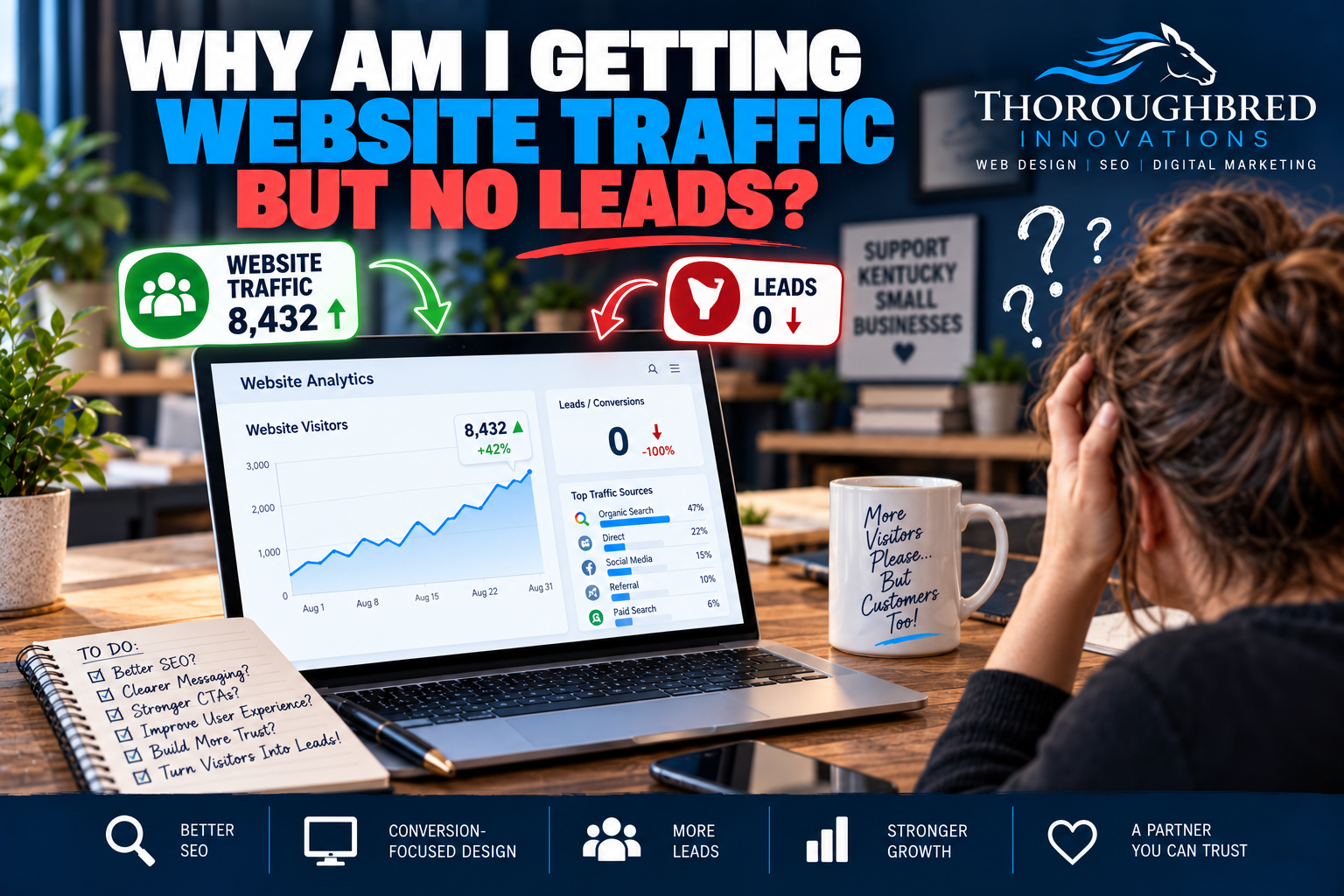
Seeing your website traffic increase should feel like a win.
More people are finding your business. Your SEO efforts may be gaining traction. Blog articles are attracting visitors. Your Google Business Profile might be sending people to your site. Social media could be working. Maybe you’re even paying for advertising that consistently brings new visitors.
There’s just one problem.
Nobody is contacting you.
The phone isn’t ringing. Quote requests aren’t coming in. Contact forms remain empty. Appointment bookings haven’t changed.
If you’re experiencing website traffic but no leads, getting more visitors isn’t necessarily the answer. The problem may be what happens after those visitors arrive.
A successful business website has two major jobs:
1. Attract the right people.
2. Give those people a compelling, easy path toward becoming customers.
At Thoroughbred Innovations, we approach websites with both sides of that equation in mind. Professional web design, SEO, content, user experience, performance, and conversion strategy should work together. A website shouldn’t simply accumulate visitors—it should create opportunities for your business.
So, why are you getting website traffic but no leads?
Let’s look at some of the most common reasons.
Website Traffic but No Leads? Start With the Traffic Itself
Not all website traffic is valuable.
Imagine owning a roofing company in Lexington, Kentucky.
Your website receives 10,000 visitors this month.
Sounds incredible.
But suppose most of those visitors arrived because you published a popular article about the history of roofing materials. They came from across the United States—and many are students researching a school assignment.
Technically, you have traffic.
But those visitors probably aren’t going to request a roof inspection in Lexington.
Now imagine another roofing company receives only 500 visitors.
Most searched phrases such as:
“roof repair Lexington KY”
“roofing contractor near me”
“roof inspection Lexington”
Those 500 visitors could be considerably more valuable to that business because their searches indicate stronger commercial and local intent.
This is why traffic alone can be misleading.
When diagnosing website traffic but no leads, ask:
Who are these visitors?
Where did they come from?
What did they search for?
What pages did they enter through?
Are they located in your service area?
Does their intent match what your business sells?
The goal isn’t simply more traffic.
It’s more of the right traffic.
1. You’re Targeting the Wrong Keywords
SEO can technically succeed while the business results disappoint.
You could rank extremely well for keywords that aren’t closely connected to your customers, which causes a lot of website traffic but no leads.
Suppose a plumbing company publishes dozens of articles targeting broad DIY searches:
“how does plumbing work”
“history of indoor plumbing”
“types of plumbing pipes”
Those topics may generate visitors.
But compare them with searches such as:
“emergency plumber Lexington KY”
“water heater repair near me”
“plumber for leaking pipe”
The intent is very different.
Someone researching the history of plumbing may simply want information.
Someone searching for an emergency plumber probably wants a plumber.
That doesn’t mean educational content is worthless. Helpful informational content can introduce your company to potential customers, demonstrate expertise, build topical relevance, earn links, and answer questions people have earlier in the buying process.
But your SEO strategy shouldn’t confuse traffic generation with lead generation.
Keyword strategy needs to account for search intent, otherwise you’ll get lots of website traffic but no leads.
LeadInfo’s guide to getting more leads emphasizes creating useful, compelling content for readers while helping search engines understand it. SEO isn’t simply about getting as many people as possible through the door.
It’s about helping the right people discover useful information.
2. Visitors Don’t Immediately Understand What You Do
Someone lands on your homepage.
What do they see?
“Welcome to Our Website.”
“Providing Innovative Solutions.”
“Committed to Excellence.”
Okay.
But what do you actually do?
Vague marketing language is one of the easiest ways to lose a potential customer, causing lots of website traffic but no leads.
A strong homepage should quickly communicate:
What your company does
Who you help
Where you operate
Why someone should consider you
What the visitor should do next
Compare: “Innovative solutions for a better tomorrow.“
with: “Professional basement waterproofing for homeowners throughout Central Kentucky. Schedule your free inspection.”
The second message actually tells the visitor something.
Your customer shouldn’t have to solve a riddle before they can give you money.
If you’re receiving website traffic but no leads, review your website as though you’ve never encountered your business before.
Would you immediately know what the company does?
If not, your visitors may not either.
3. Your Website Doesn’t Have Clear Calls-to-Action
You’ve attracted the right visitor.
They understand your business.
They like what they see.
Now what?
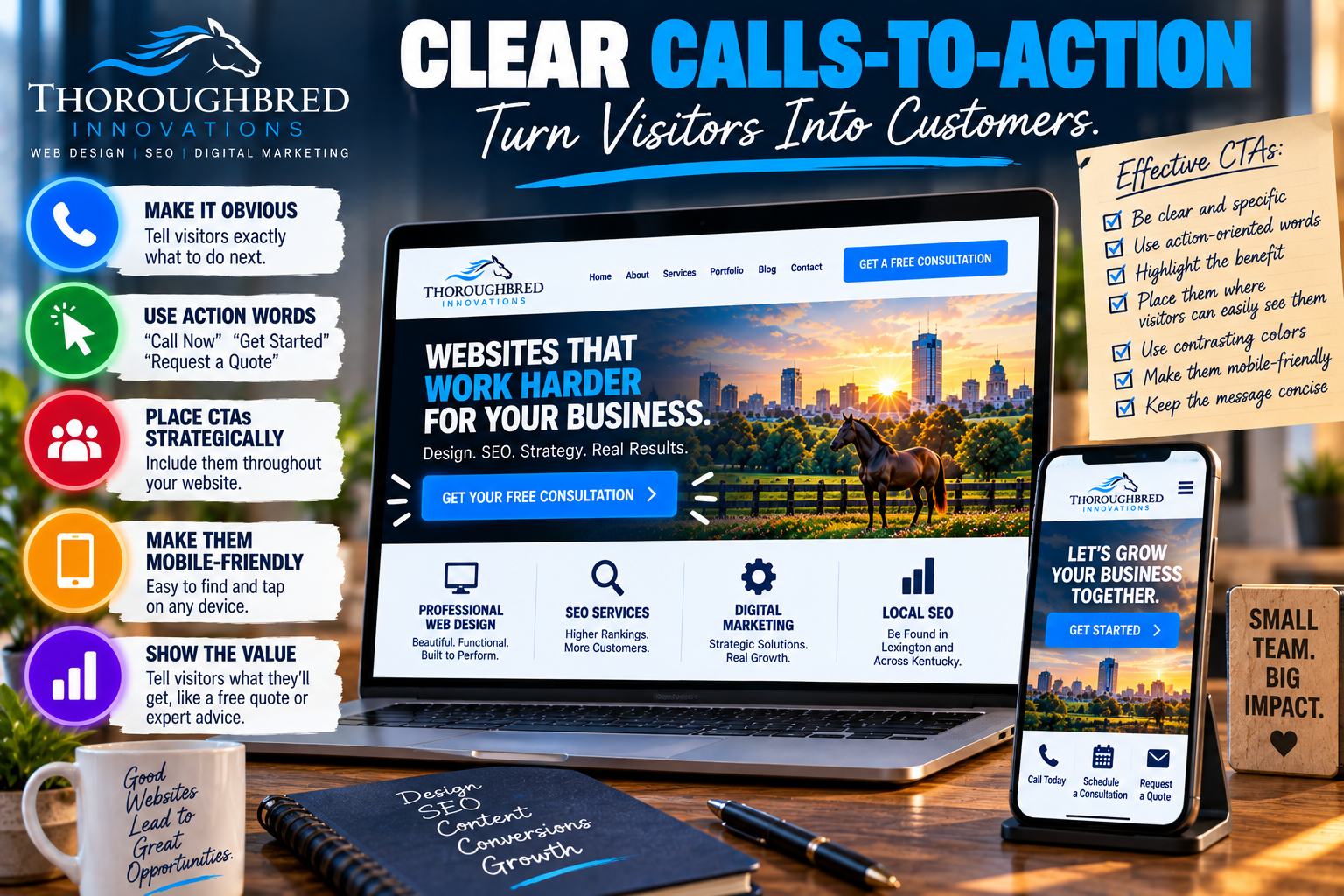
A website should guide visitors toward the next logical step.
That step might be:
Call Today
Request a Free Quote
Schedule an Appointment
Book a Consultation
Get Started
Order Online
Request an Inspection
Visit Our Store
These are calls-to-action, or CTAs.
A surprisingly common reason businesses see website traffic but no leads is that visitors aren’t given a clear next step.
Maybe the phone number is buried in the footer.
Maybe the only contact button appears once in the navigation.
Maybe a 1,500-word service page ends without telling the visitor what to do.
Maybe the CTA says something vague like “Learn More” when the visitor is already ready to request service.
Thoroughbred Innovations discusses this in our guide on how to turn your website into a lead-generating machine. Clear value propositions, strategically placed calls-to-action, simplified navigation, and conversion-focused page design can all help create a more intentional path from visitor to lead.
Don’t make customers hunt for the next step, otherwise you’ll get lots of website traffic but no leads.
4. Your Contact Forms Ask for Too Much
You’ve seen these forms.
A customer wants an estimate.
The website wants:
First name.
Last name.
Email.
Phone number.
Address.
City.
State.
ZIP code.
Company.
Job title.
Annual revenue.
How they heard about you.
Preferred contact method.
Preferred contact time.
Detailed project description.
Estimated budget.
Desired completion date.
Every unnecessary field creates another opportunity for someone to decide:
“I’ll do this later.”
And “later” frequently becomes never.
Forms should collect the information your business genuinely needs to take the next step.
More complicated projects may legitimately require more information. But don’t turn an initial inquiry into a mortgage application unless there’s a real business reason, or else you’ll get a lot of website traffic but no leads.
Test your forms yourself, too.
Does submission work?
Is it easy on a smartphone?
Are error messages clear?
Does the business actually receive the notification?
A beautifully designed form that sends inquiries into the digital abyss is a fast way to get website traffic but no leads.
5. Your Website Doesn’t Build Enough Trust
Customers take a risk when contacting an unfamiliar business.
They’re wondering:
Is this company legitimate?
Are they experienced?
Will they answer?
Can they actually solve my problem?
Do other customers trust them?
Will I regret giving them my information?
Your website should help answer those questions, otherwise you’ll get a lot of website traffic but no leads.
Depending on the business, trust signals could include:
- Customer testimonials
- Google reviews
- Awards
- Certifications
- Licenses
- Years of experience
- Professional affiliations
- Project photographs
- Case studies
- Team information
- Real company photographs
- A physical business address
- Clear contact information
- Guarantees or warranties, when applicable
- Detailed service information
The key is authenticity.
Don’t add meaningless badges simply because they look impressive.
Show visitors real reasons to trust your business.
Thoroughbred Innovations’ approach to professional web design services specifically considers credibility, calls-to-action, testimonials, reviews, awards, project examples, FAQs, and service information as parts of a conversion-focused customer journey.
6. Your Website Is Too Slow
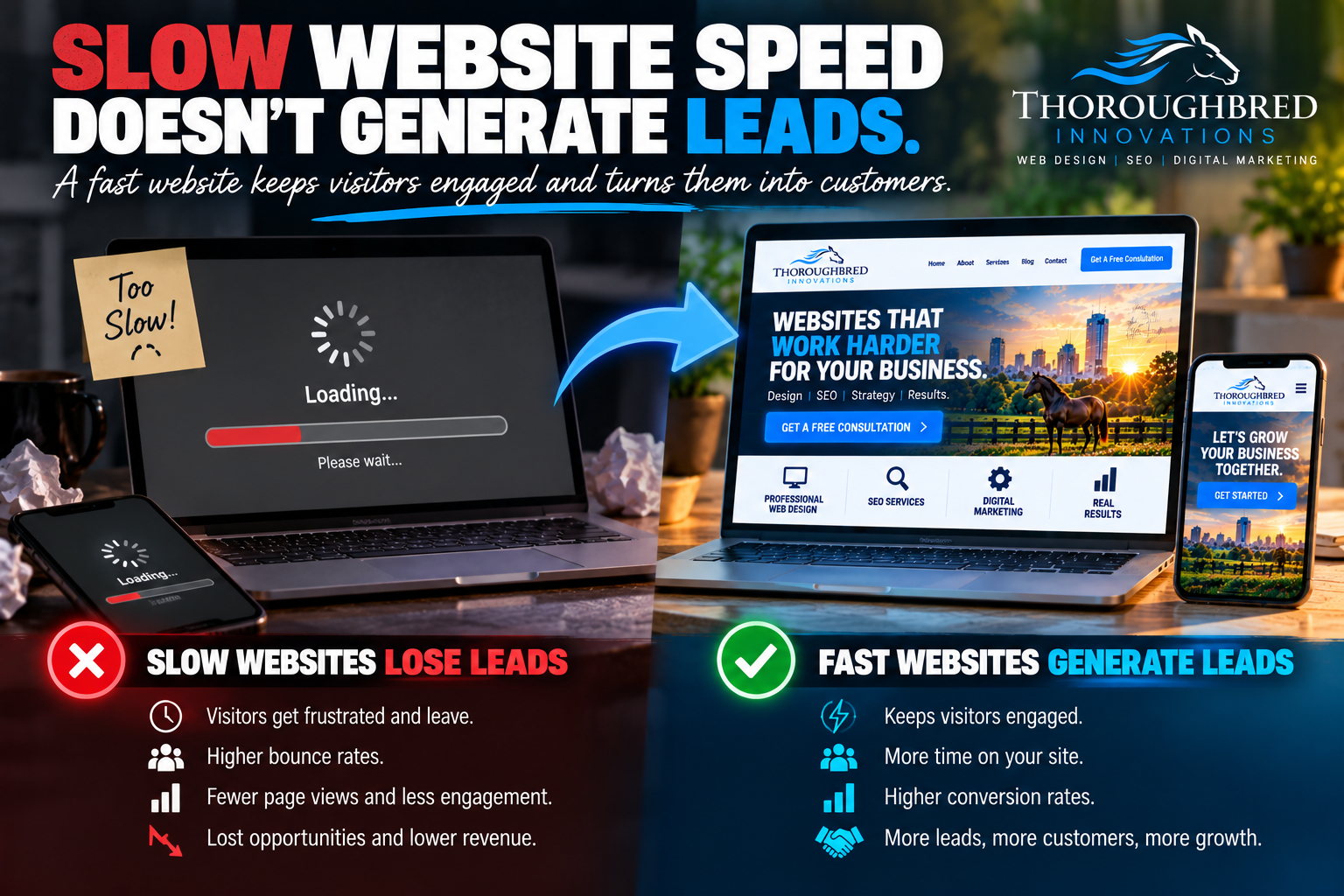
You can’t generate a lead from someone who gets frustrated before your page becomes usable.
Website performance matters because every unnecessary delay adds friction to the customer journey.
Large images, bloated themes, excessive plugins, poorly implemented scripts, inefficient code, third-party resources, and hosting limitations can all contribute to sluggish performance.
Google recommends evaluating page experience holistically and specifically asks website owners to consider Core Web Vitals, mobile display, secure delivery, intrusive interruptions, and whether visitors can easily distinguish the page’s main content.
Performance isn’t merely an SEO checkbox.
It’s a customer experience issue.
Imagine someone urgently searching for a plumber because water is pouring through their ceiling.
They click your website.
Loading…
Loading…
Loading…
They’re probably not admiring your patience-testing animation.
They’re hitting the back button. Website speed is a big reason of how you get website traffic but no leads.
7. Your Mobile Experience Is Frustrating
Pull out your phone and visit your own website.
Don’t just look at the homepage.
Actually use it.
Open the menu.
Visit a service page.
Tap the phone number.
Complete the contact form.
Read an article.
Try to request a quote.
Can you do everything comfortably?
Mobile problems that can hurt conversions include:
Tiny buttons
Unreadable text
Horizontal scrolling
Menus that don’t work
Forms that are difficult to complete
Pop-ups covering the screen
Phone numbers that aren’t clickable
Slow-loading images
Important information buried far down the page
Layout elements jumping around while loading
Google uses mobile-first indexing, meaning Google uses the mobile version of your website as the primary basis of your website for indexing and ranking, not the desktop version.
Poor mobile experience can be a big reason why you’re getting website traffic but no leads.
A responsive website isn’t one that merely fits on a phone.
It should be easy to use on a phone.
8. Your Content Doesn’t Answer the Questions Customers Have
Imagine visiting a service page and finding this:
Our Services
“We provide high-quality solutions with exceptional customer service. Contact us today to learn more!”
That’s not particularly helpful.
What service?
Who is it for?
What’s included?
What problems does it solve?
What should the customer expect?
Where is it available?
Why should someone choose this company?
Strong service pages should anticipate customer questions.
The visitor may want to know:
Do you offer the service I need?
Do you serve my location?
Can you solve my particular problem?
What does the process involve?
What makes your business different?
What should I do next?
Content should reduce uncertainty.
That’s one reason Thoroughbred Innovations combines content strategy with web marketing and design. Attracting a visitor is only part of the process; the website also needs to engage that visitor, establish trust, and encourage meaningful action- otherwise you’ll get lots of website traffic but no leads.
9. Your Landing Page Doesn’t Match the Visitor’s Intent
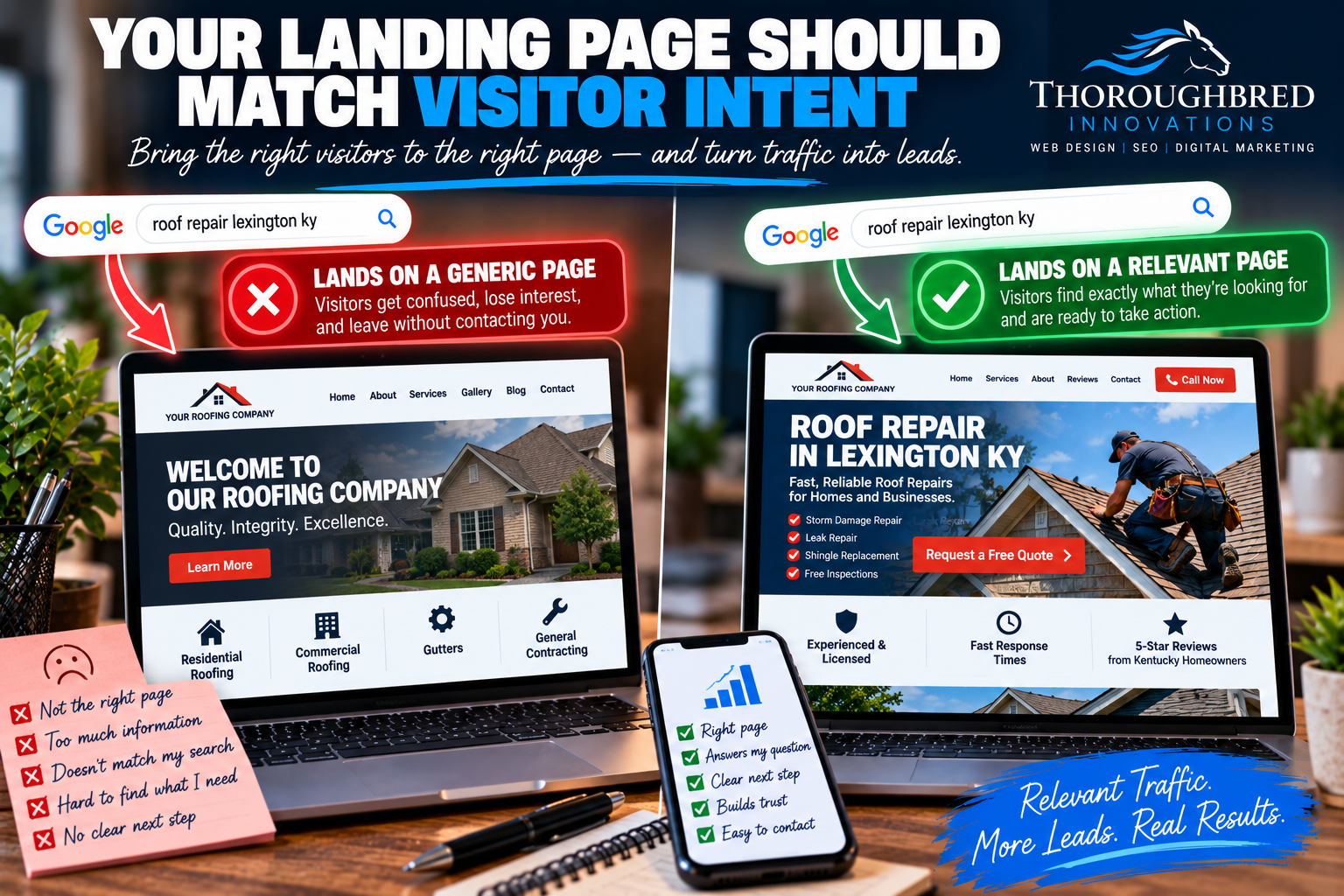
Imagine searching:
“commercial roof repair Lexington KY”
You click a result.
And land on a generic homepage that talks about residential shingles, company history, community involvement, financing, gutters, and six unrelated services.
Somewhere—maybe—you’ll find commercial roofing. Unclear search intent will produce a lot of website traffic but no leads.
That’s unnecessary friction.
The closer a landing page matches what the visitor was looking for, the easier it is for that person to determine whether the company can help.
If someone searches for a specific service, a dedicated service page can often provide a clearer experience than sending every visitor to the homepage.
That page can address:
The specific service
Common problems
Who needs it
How the business helps
Service area
Frequently asked questions
Trust signals
Relevant proof
A clear CTA
SEO shouldn’t merely determine whether someone reaches your website.
It should help them reach the right page.
10. Your Website Looks Outdated or Unprofessional
Visitors make judgments quickly.
That doesn’t mean every small business needs the world’s fanciest website.
In fact, unnecessary design complexity can make a website worse.
But your site should look intentional, current, trustworthy, and consistent with your business. Outdated web design or information could lead to lots of website traffic but no leads.
Potential warning signs include:
Broken images
Outdated information
Old branding
Inconsistent fonts and colors
Cluttered layouts
Poor-quality photographs
Broken links
Tiny text
Confusing menus
Outdated copyright information
Pages that don’t work properly
A customer doesn’t necessarily know why the website feels wrong.
They just know something feels off.
Your website represents your business before you ever have the opportunity to speak with that visitor.
Professional design isn’t about showing off.
It’s about making the business feel credible and easy to work with.
11. You’re Attracting Visitors Too Early in the Buying Journey
Sometimes you get a lot of website traffic but no leads.
And that’s okay.
Someone reading:
“What is basement waterproofing?”
may be researching.
Someone searching:
“basement waterproofing company Lexington KY”
may be much closer to hiring someone.
Both visitors can be valuable.
They simply occupy different stages of the customer journey.
This is where internal linking and content strategy become useful.
An educational article can naturally guide a visitor toward:
A relevant service page
A related guide
A case study
An FAQ
A consultation
A quote request
Your blog shouldn’t become a dead end.
Educational content can answer the initial question and then provide an appropriate next step for readers who want additional help.
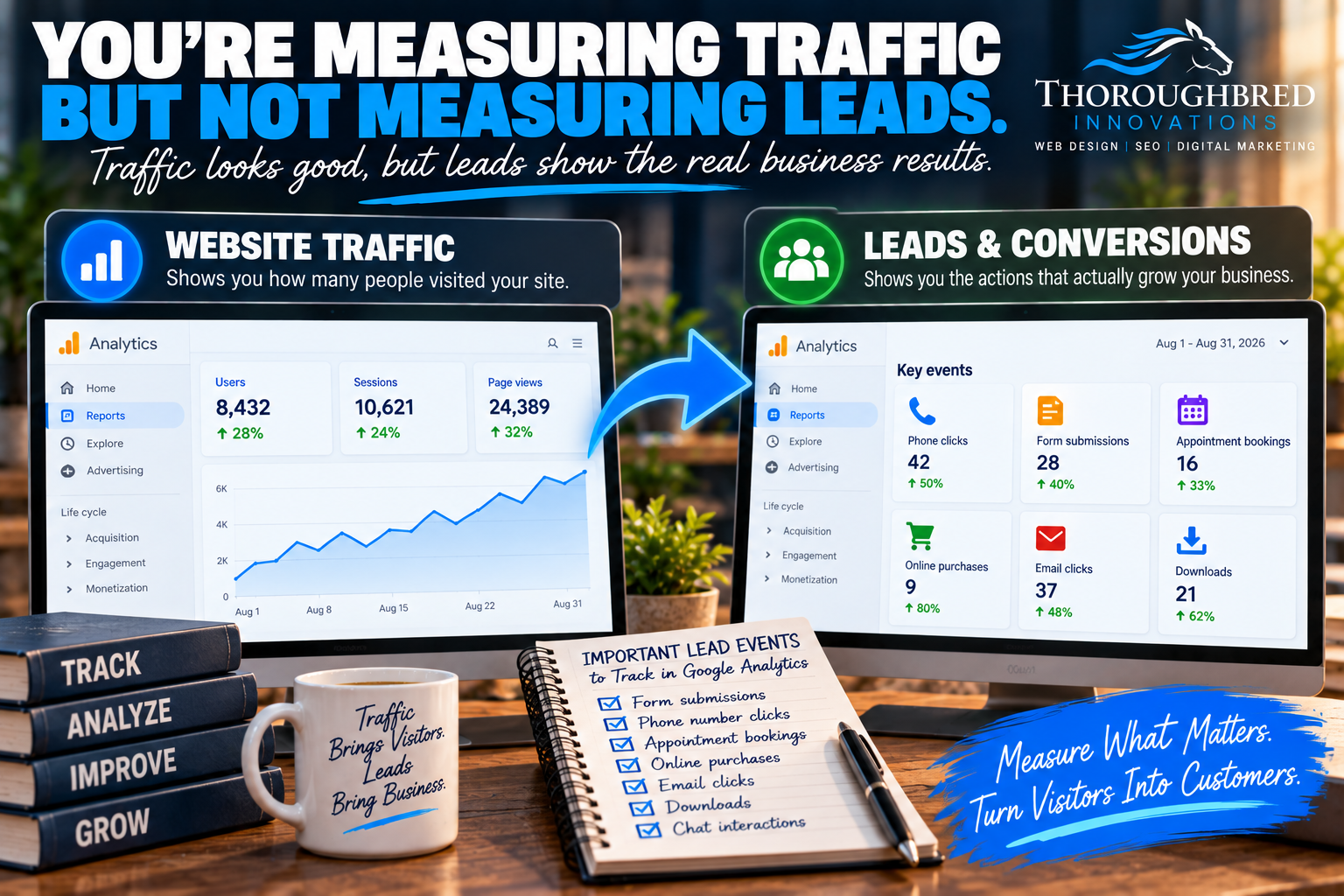
12. You’re Measuring Traffic but Not Measuring Leads
Here’s another possibility:
Your website is generating leads, but your analytics aren’t configured to measure them properly, so it seems like you’re getting lots of website traffic but no leads.
Traffic is easy to notice.
Conversions require intentional tracking.
Depending on your business, valuable actions might include:
Contact form submissions
Phone-number clicks
Quote requests
Appointment bookings
Purchases
Email clicks
Downloads
Newsletter registrations
Google Analytics allows businesses to mark actions that are particularly important to them as key events. Those events can then be used to evaluate user behavior and marketing performance across the channels that contributed to them.
Google Search Console can provide another piece of the puzzle by helping you understand how people are finding the website through Google Search.
The point isn’t to collect every metric imaginable.
It’s to connect marketing activity with business outcomes.
Stop Obsessing Over Traffic Numbers
This is one of the most important lessons for any business experiencing website traffic but no leads:
More traffic isn’t automatically better.
Suppose Website A gets:
10,000 monthly visitors and 10 qualified inquiries.
Website B gets:
2,000 monthly visitors and 50 qualified inquiries.
Which business would you rather be?
Website A has the prettier traffic graph.
Website B has more opportunities.
Small businesses shouldn’t pursue traffic merely because a larger number looks impressive in a report.
The goal should be attracting relevant visitors and creating an experience that helps the right people become customers.
How to Diagnose Website Traffic but No Leads
If you get lots of website traffic but no leads, work through the customer journey from beginning to end.
Ask yourself:
Traffic: Are we attracting people who could realistically become customers?
Intent: Are our keywords aligned with our services?
Landing pages: Are visitors reaching pages relevant to what they searched for?
Messaging: Can visitors immediately understand what we do?
Trust: Have we given them reasons to feel confident?
Content: Have we answered their important questions?
UX: Is the website easy to navigate?
Mobile: Does everything work properly on smartphones?
Performance: Does the site feel fast and responsive?
CTA: Is the next step obvious?
Forms: Is contacting us easy?
Tracking: Are we accurately measuring valuable actions?
Don’t immediately assume SEO failed simply because leads aren’t arriving.
SEO may have successfully brought people through the front door.
The problem could be everything that happens afterward.
Turning Website Traffic Into Leads
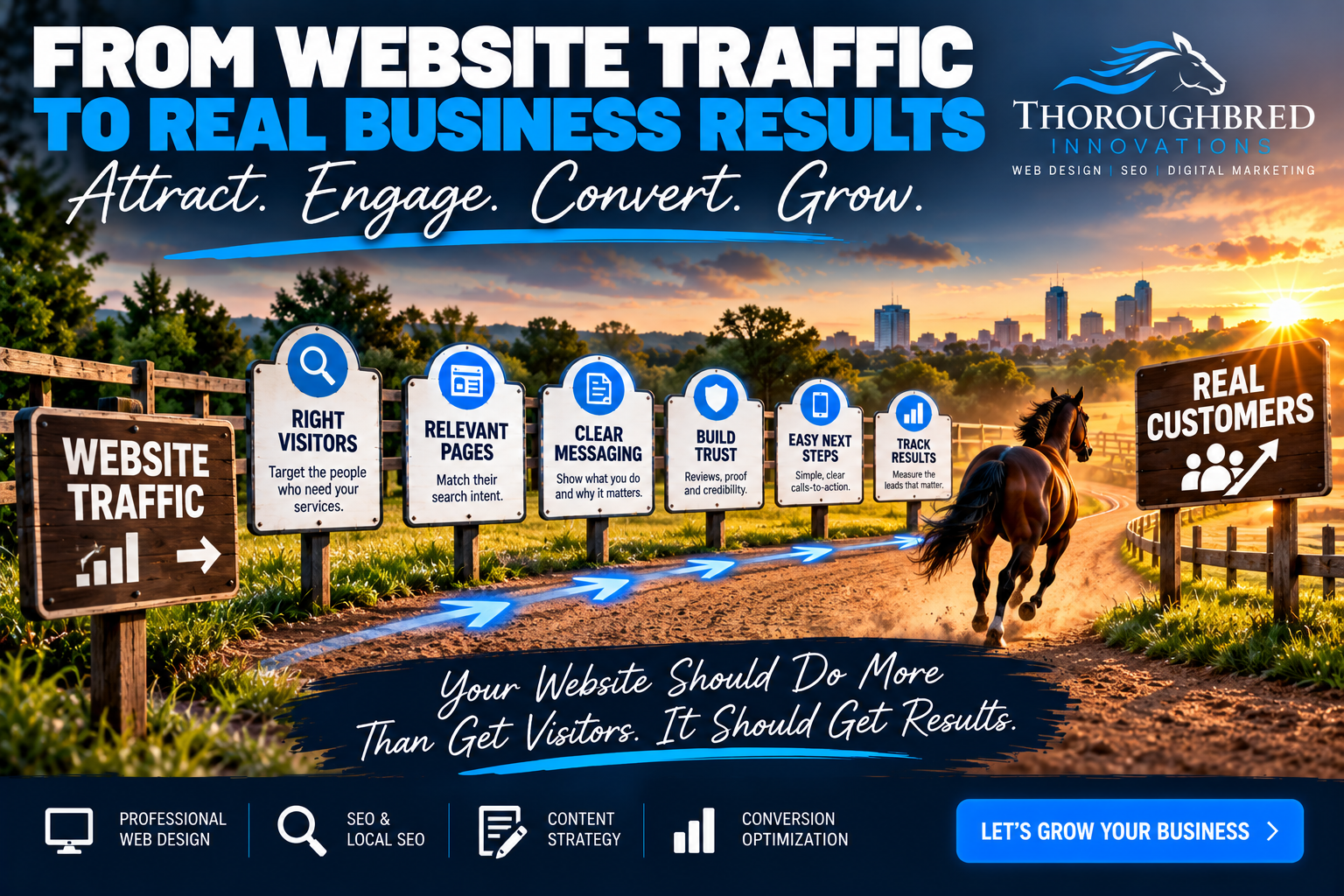
The solution to website traffic but no leads isn’t one magical button color, pop-up, SEO trick, or headline.
Conversion improvement usually comes from reducing friction throughout the customer journey.
A stronger solution to website traffic but no leads might combine:
Relevant SEO traffic
→ A page matching search intent
→ Clear messaging
→ Useful information
→ Professional design
→ Trust signals
→ Fast, mobile-friendly performance
→ A compelling call-to-action
→ An easy contact process
→ A new lead
That’s why web design and marketing shouldn’t be treated as completely separate projects.
Your marketing brings people in.
Your website needs to take it from there.
Thoroughbred Innovations Builds Websites Around Business Results
At Thoroughbred Innovations, we don’t believe the purpose of a small-business website is simply to exist.
And we don’t believe SEO should be measured exclusively by how many people visited.
A business needs opportunities.
That’s why our approach to web design and digital marketing brings together:
Web Design
Web Development
SEO
Local SEO
Content Strategy
Website Performance
Mobile Optimization
User Experience
Accessibility
Conversion Strategy
Ongoing Website Management
Our current professional web design services are built around this broader philosophy: start by assessing why there’s website traffic but no leads, what the website needs to accomplish, then make design, content, SEO, performance, accessibility, UX, and conversion strategy support that objective.
Because traffic isn’t the finish line.
It’s the beginning of the customer journey.
Website Traffic but No Leads? Your Website May Be the Missing Piece
If you’re getting website traffic but no leads, don’t immediately assume you need twice as much traffic.
Look deeper.
Maybe you’re targeting the wrong searches.
Maybe visitors don’t understand your offer.
Maybe your website isn’t establishing enough trust.
Maybe your contact process creates unnecessary friction.
Maybe mobile visitors are struggling.
Maybe your landing pages don’t match search intent.
Maybe your calls-to-action are practically invisible.
Or maybe you’re generating valuable customer actions and simply aren’t tracking them correctly.
The solution begins by understanding where the customer journey is breaking down.
At Thoroughbred Innovations, we help small businesses connect web design, SEO, content, performance, user experience, and conversion strategy so that their websites aren’t merely attracting visitors—they’re built to create business opportunities.
Your traffic already got people through the door.
Now let’s give them a reason to stay, trust you, and take the next step.
Have website traffic but no leads? Thoroughbred Innovations is here to help!